- Packing guide
- Liquids rules
- Toiletries
How to pack toiletries in a carry-on: the liquids rules in 2026
The liquids rules aren't what they were, and they aren't the same everywhere. Pack your toiletry kit the right way and it'll get through security at any airport.
 By JPott Studios
About 6 minutes to read
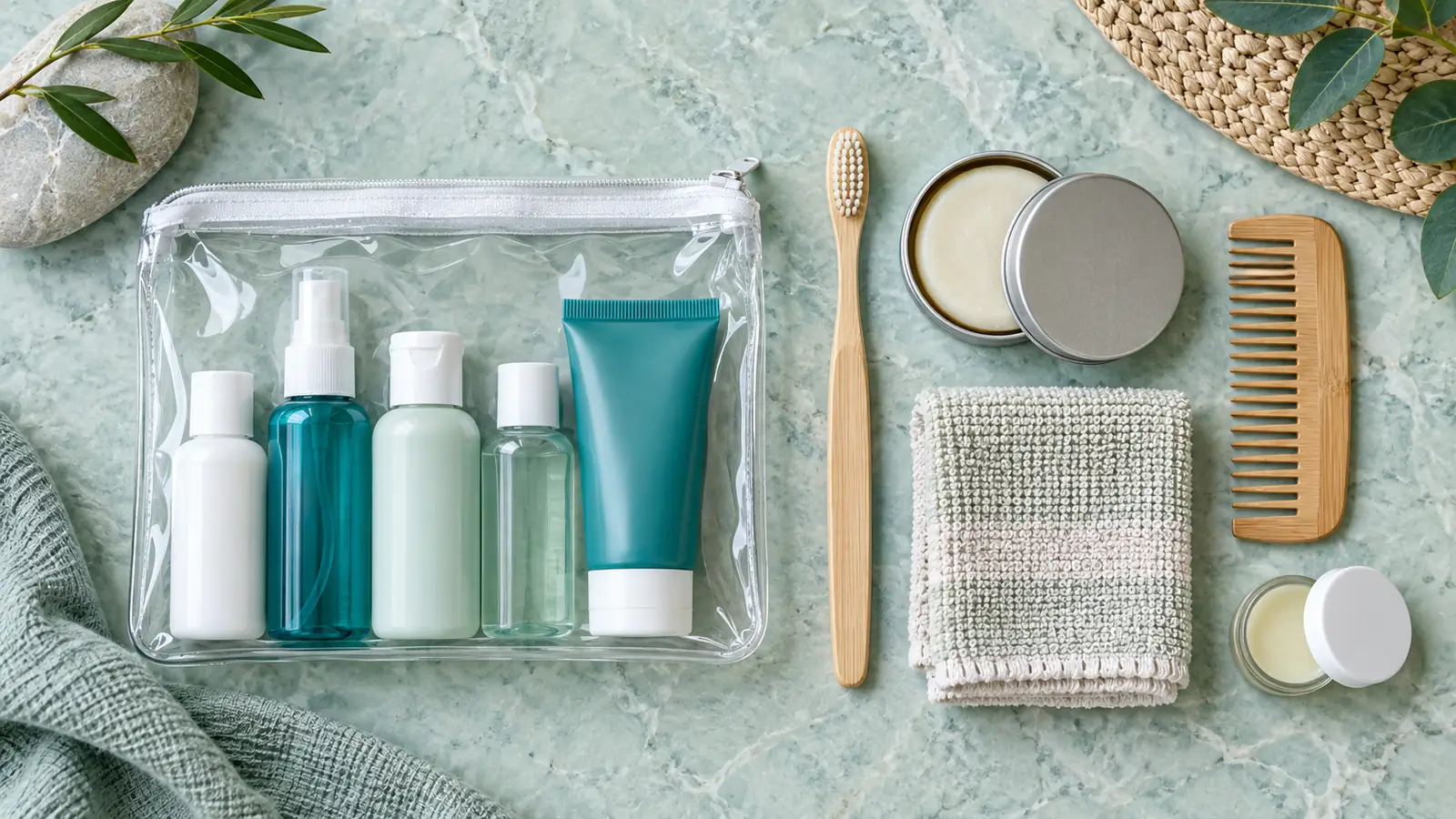
To pack toiletries in a carry-on, put every liquid in a container of 100ml (3.4 ounces) or less, fit them all in one clear, resealable bag, and swap whatever you can for solid bars and sticks. That gets you through security almost anywhere. Some airports now allow more, but you can't count on it for the whole trip.
Dated guidance. This was written in September 2026. Liquids rules have changed several times since 2024 and still differ between airports, sometimes even between terminals of the same airport. Before you fly, check the security page of every airport on your trip, including the one you fly home from.
The two liquids rules you might meet in 2026
For years there was one familiar rule. Now there are two, and the airport decides which one applies.
- The classic rule. Liquids in containers of 100ml or less, all in one clear, resealable bag, taken out of your bag at security. In the UK and Europe the bag is usually around 20cm by 20cm and holds up to a litre. In the US it's known as 3-1-1: containers of 3.4 ounces or less, in one quart-sized bag, one bag per person.
- The newer rule. Some airports have newer scanners that can see inside your bag more clearly. They may allow containers up to 2 litres and let you leave liquids in your bag, though not every lane has them. In the US, some lanes with these scanners let the liquids bag stay in your case, but the 3.4 ounce limit still applies.
| The classic rule | The newer rule | |
|---|---|---|
| Container size | 100ml or less (3.4 ounces in the US) | Up to 2 litres, at some airports |
| The bag | One clear, resealable bag, about 20 by 20cm or a quart | Liquids may stay in your bag |
| At security | Taken out of your bag | Left in your bag |
| Where | Accepted everywhere | Only some airports, and not every lane |
The simple way through: pack to the classic rule unless you've checked every airport on your trip. It's accepted everywhere. And the airport you fly home from may be stricter than the one you left from. The return leg is where most bottles get binned.
What counts as a liquid?
More than you'd think. If you can pour it, squeeze it or spread it, treat it as a liquid.
- Toothpaste, mouthwash and gel
- Shampoo, conditioner, shower gel and face wash
- Moisturiser, sunscreen and hand cream
- Mascara, liquid foundation, lip gloss and nail polish
- Roll-on and gel deodorant
- Perfume, hairspray and other aerosols
- Contact lens solution and hand sanitiser
- Food that spreads or pours, like honey, jam, peanut butter and yoghurt
Where the 100ml rule applies, it's the size of the container that matters, not how much is left inside. A 200ml bottle with a little shampoo at the bottom will usually be taken away.
Is it a liquid?
Can you pour it, squeeze it or spread it?
Toothpaste, mascara, lip gloss, gel deodorant, sunscreen, peanut butter.
Bar soap, shampoo and conditioner bars, stick deodorant, toothpaste tablets.
The easiest trick: go solid
Solids aren't liquids, so they don't take up room in your little bag. Swapping even two or three items makes the whole thing easier.
- Bar soap instead of shower gel
- Shampoo and conditioner bars
- A stick deodorant instead of roll-on or spray
- Toothpaste tablets
- A solid perfume or a small roll-on in your liquids bag
- Powder or stick makeup instead of liquid
- A sunscreen stick for your face
Keep bars in a small tin or a sealed pouch so they don't soften everything around them. One caution: loose powders can get a closer look at security, so put large amounts of powder in your checked bag if you have one.
How to decant without spills
Start with proper travel bottles that have the size printed on them. Soft silicone squeeze bottles are easy to use; hard plastic ones leak less.
Fill each one to about three quarters, because pressure changes in the air can push liquid out of a full bottle, and squeeze the air out of soft bottles before you close them. A small square of cling film under the cap, or a strip of tape around it, stops slow leaks.
Label everything, because shampoo and conditioner look identical in a clear bottle at 7am. And take less than you think. Most people use about a teaspoon of shampoo per wash, so a week rarely needs a full 100ml.
Can you take medicine or baby milk over 100ml?
Often, yes, but you need to say so.
Liquid medicines you need during the trip can generally go over the limit. In the UK, liquid medicine in a container over 100ml needs proof, such as a copy of the prescription or a letter from your doctor. In the US, TSA allows medically necessary liquids in reasonable quantities as long as you declare them. Either way, tell the officer before your bag goes through and take the medicine out separately. Tablets need nothing special.
Baby milk and food are usually allowed over the limit too, with rules that vary by country. Our guide to packing with a baby or toddler covers the details.
For contact lens solution, pack a small bottle in your liquids bag and buy more when you arrive, unless you've checked that your airport treats it as medical.
The rest of the bag: sharp things and aerosols
Cartridge and disposable razors are generally fine in hand luggage, but loose blades aren't. Small nail scissors, clippers and tweezers are usually fine too. Rules on blade length vary, so leave anything bigger at home.
Aerosols play by two sets of rules. In hand luggage they count as liquids. In checked bags, toiletry aerosols usually have a limit per can and a total limit, and the nozzle needs a cap.
From JPott Studios
One calm email a month
One useful tip, one free printable or tool, and a short note from our apps. Join and get the free welcome pack: printable trackers, a packing list maker and more.
A complete carry-on toiletry kit
Items in italics go in the clear liquids bag.
- Toothbrush and a cover
- Small toothpaste, or toothpaste tablets
- Stick deodorant
- Shampoo and conditioner bars, or small bottles
- Bar soap in a tin
- Face wash and moisturiser
- Sunscreen, plus a sunscreen stick
- Lip balm (a solid stick is fine outside the bag)
- Hairbrush or comb, hair ties and clips
- Razor
- Nail clippers and tweezers
- Contact lens solution, lenses, case and your glasses
- Period products
- Cotton buds and a few plasters
- Small hand sanitiser
- Medication, with a couple of days spare, in its original packaging
For a week in one bag, our carry-on packing list for a week shows how the kit fits in with everything else. Travel for work a lot? The business trip packing list has a few extras for long days. And if you're off somewhere sunny, the Caribbean island packing list explains reef-safe sun care.
At security
Pack the liquids bag on top, where you can lift it out in one move, and empty your water bottle before the queue. That goes even at airports with the newer rule, because a metal bottle can't be seen through.
Duty free is different. Liquids bought after security are usually fine on board, but if you change planes, keep them sealed in the shop's bag with the receipt, as you may be screened again.
Where Neatly Packed helps
Neatly Packed puts your toiletries on your packing list for you, and it has a free Liquids and bags guide with the rules in plain words. Each rule says how firm it is: much the same worldwide, depends where you fly from, or your airline decides. It shows the date it was last checked and reminds you to check the airport you fly home from too. For a quick printable list, try our free packing list maker.
Questions people ask
Is the 100ml liquids rule still in place?
At many airports, yes. Some airports with newer scanners now allow larger amounts that can stay in your bag, but it depends on the airport, and sometimes on the terminal or lane. As of September 2026, the safe approach is to pack to the 100ml rule unless you've checked the rules for every airport on your trip.
Does a half-empty large bottle count as under 100ml?
Usually not. Where the 100ml rule applies, it's the size of the container that counts, not how much is left inside. Decant into a small bottle marked 100ml or less.
Is toothpaste a liquid at airport security?
Yes. Anything you can pour, squeeze or spread counts, including toothpaste, mascara, lip gloss, gel deodorant and sunscreen. Toothpaste tablets and solid bars avoid the question entirely.
Can I take medicine over 100ml in my hand luggage?
Essential liquid medicines are generally allowed over the limit, but you may need proof, such as a copy of the prescription or a doctor's letter, and you should tell the security officer before your bag is screened. Check your departure airport's guidance.
Can I bring duty free liquids on board?
Liquids bought after security are usually allowed on board. If you change planes you may go through security again, so keep them in the sealed bag the shop gives you, with the receipt, and check the rules for your connecting airport.
From JPott Studios
One calm email a month
One useful tip, one free printable or tool, and a short note from our apps. Join and get the free welcome pack: printable trackers, a packing list maker and more.